ROLE OF EDUCATION
There is a great deal of anxiety at the present time among all people that moral values are
disintegrating on all fronts, in both public and personal life. Man, today stands on crossroads, as he
helplessly witnesses the strange paradox; on the one hand new milestones of man’s conquest of matter and
space, and on the other a directionless quest for an elusive peace and happiness
Today’s schools emphasize academic achievement and physical skills to the exclusion of developing
human beings of noble character. Students are taught to qualify for merely earning a living, which
results in an attitude of acquisition and self-interest. This has led to a decline in integrity of
family life, waning of respect for parents and teachers, destructive behavior in social institutions,
and lack of purpose and direction among the youth leading to permissiveness and conflict in public life.
Education should lead children to imbibe the basic values that are essential to any worthy life.
The values and the process of enfoldment should encompass a full vision of human potential. Personality
is fully integrated where there is harmony and consistency in thought, word and deed. Since
blossoming of human personality amounts to good character, the aim of education and the aim of
life are identical, i.e., inculcation and practice of human values.
The Supreme Court of India,
vide its judgement in the writ petition No. 98 of 2002, dated 12th September 2002, stated that “social
values aimed at friendliness, co-operation, compassion, self-discipline, courage, Truth, Righteous
Conduct, Peace, Love and Non-Violence are the core universal values that are the foundation for
building a Value based Education system… People must realize who they are and what is the ultimate
purpose of human life. Self-recognition would come to them through proper value education that would
facilitate their spiritual march… There is an organic link between the Human Values and Human
Personality. Mental happiness comes from peace, peace comes from love, love is linked with non-violence,
non-violence is the outcome of righteous conduct without truth cannot be thought of. One human value
without the other cannot be thought of.
The philosophical, cultural and ethical heritage, the psychological and scientific insights, should
enable us to reach a consensus on the aim of education transcending doctrinal or sectarian boundaries.
Sathya Sai Educare provides a Plan of Action for re-establishing values in our life, by redeeming
mankind from the veil of ignorance, to achieve universal peace and harmony. Educare is also the art of
ensuring a perfect balance of the five elements within by managing the mind and inputs from the five
senses, such that the divine energy from within flows uninterrupted.
THE FOUNDATIONS OF SATHYA SAI EDUCARE
Inspired and guided by Bhagawan Sri Sathya Sai Baba, there is a powerful sense of Unity in the development and implementation of the Sri Sathya Sai Educare curriculum throughout the world. Each country has adopted the curriculum in a unique way to suit its culture and social ethos, yet there is a clear agreement on the specific components, which go together to make up the curriculum of Sri Sathya Sai Education in Human Values. The SevenSalient Features of Sri Sathya Sai EHV program are:
- God is the seed - The programme rests firmly on the recognition and acceptance that
divinity permeates the entire creation, and is inherent in every individual. God is the seed
and Divinity is the source of all human values. Baba had warned:
“What some people do is they give training to teachers, who then begin to teach in schools. They do not make any mention of Divinity, what sort of value is it? What right do you have to speak on human value without including Divinity? If they don’t like it, let us not go there. Let us go top to those people who respond to our thinking.” Sri Sathya Sai Baba (13-January-1992)
- Unity of Faiths All religions teach the one Truth. Baba says
“There is only one religion and that is the religion of Love. There is only one caste, the caste of Humanity.
No scripture enjoins violence or lays down untruth as a way of life. All religions extol Truth, Righteousness, Peace, Brotherhood and Love. All saints are embodiments of service, compassion and renunciation.” Sri Sathya Sai Baba (20-November-1993)) - The Five Cardinal Human Values are universal and eternal. They constitute the
transcendental aspects of education and form the bedrock of the Sathya Sai Educare programme.
“EHV means education plus the practice of Human Values. Education cannot be merely acquired from books without any action. All the five values – Sathya (Truth), Dharma (Righteousness), Prema (Love), Shanti (Peace, & Ahimsa (Non-violence) have to be practised. Truth is not Truth until it is spoken as Truth, Dharma (Right Action) is not Dharma until it is practised. Peace is not Peace until it is experienced. Likewise, Prema (Love) and Ahimsa (Non-violence) can only be experienced if practised, as these are both natural qualities in a true human being. ” Sri Sathya Sai Baba (20-November-1992)
- EHV is 3HV
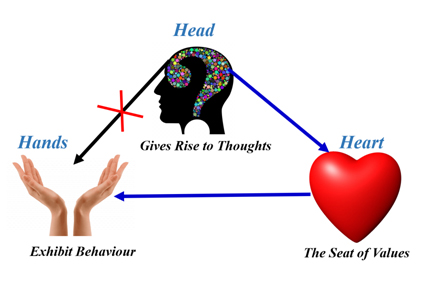
“The Heart, Head and Hands should cooperate and function in harmony. There is no human value greater than this. Thoughts, words and deeds must be the same. If not, these human values will disappear. Hence for this harmony this unity is essential. ” Sri Sathya Sai Baba
- The Five Transformational Techniques The Educare curriculum employs as a powerful
instructional methodology the Five Techniques of:
- Silent sitting or Tuning In; Jyothi Meditation
- Prayers and Positive Thinking
- Inspirational stories & literature
- Devotional Group Singing
- Group Activities with an integrated approach
- Role Models - Of the several factors that promote self-development,Role Model is of great
importance. Role models are individuals who inspire, they show the way, and lead others along the
path. They are exemplars of unity between thought, word and deed. Students are largely influenced by
what they see in their elders, follow in the footsteps of elders, imitate and learn. Hence
successful implementation of the programme requires a resolve on the part of the entire school
community to practise the values which we want the children to acquire in their lives.
“Parents and teachers are the sculptors who have to mould the shape and figure of the students for whom they are responsible. If parents and teachers set the right example, the students will automatically blossom into models of excellence and bring glory to the nation.” Sri Sathya Sai Baba (20-January-1988)
The End of Education is Character. The benchmark for character is unity in thought, word and deed, where there is harmony between Head (thought), Heart (feeling expressed in words) and Hands (behaviour). This is the 3HV approach.“Have a Heart full of love. Truly then EHV is 3HV. The first H Stands for Heart, the second for Head and the third for Hands. When there is harmony between these 3Hs, one becomes a great man, a God man. Human Values should reflect in our conduct in everyday life.” Sri Sathya Sai Baba (20-November-1993)
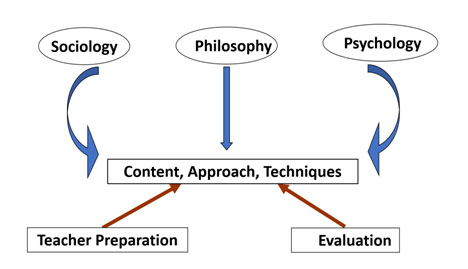
- Foundations of the Curriculum Sri Sathya Sai EHV curriculum is the one and only Value
Education programme in recorded history complete with all components of a curriculum – foundations
of educational sciences, course content, activities and techniques, instructional methodology,
evaluation procedure, and a teacher preparation module. The pedagogy of instruction is
holistic, and relates teaching to life’s real situations. Spread over several years at the
formative stage of the students, the curriculum is sequenced hierarchically from simple to complex,
from a single to multiple sub-values, and from theoretical constructs to experiential learning.
“Regarding school climate Swami says, “The actual syllabus is not so important as the creation of an atmosphere where noble habits and ideals can grow and fructify.”
While each school will pursue its academic programme to meet the requirements of the examination board, it should use a variety of techniques to provide value dimension to the activities. Keeping this in mind, a six-point common minimum programme has been suggested for all Sathya Sai Schools.
THE COMMON MINIMUM PROGRAMME
- THE SCHOOL ASSEMBLY Every Sai school should conduct a daily school assembly attended by students, teachers and the Principal. It should set the tone for the day. The daily school assembly will have Prayers, Silent Sitting, Group Singing, Story-telling or quotes etc. and a short talk on values.
- MEDITATION Silent Sitting results in superior concentration leading to better respectability, finer grasping power and sharper memory. This prepares the ground for an intuitive awakening. Group meditation is a very important technique for the successful inculcation of values. A teacher can guide from experience and this will deeply affect the children in acquiring peace within. Children can first be led into Guided Visualization with their eyes closed, and then take the students to Jyoti Meditation.
- FESTIVALS AND FUNCTIONS Festivals and functions create a feeling of goodwill, harmony and unity. Cultural activities intensify our faith, bring joy in the family, and promote the values of universal Love, charity, selfless service, patience and compassion.
- CLEANLINESS Cleanliness is Godliness. It brings out the purity of thought, word and deed. At the physical level personal hygiene promotes good health and cheerful attitude. At the mental level it develops purity of thoughts. The three C’s -Campus, Corridors and the Class rooms are the representative symbols of schools, which highlight our approach to cleanliness.
- PARENTING PROGRAMME In a tender state of childhood, teachers and parents are inseparably connected with the students in the process of learning and teaching, and leading them to Right Living. Dynamic Parenting helps parents to encourage and accept children as a whole. A balance between Love and Law should be maintained in all situations.
- EXPERIENTIAL LEARNING Experiential Learning is a holistic approach to teaching. It provides intra-integration while artificial barriers of subject disciplines disappear. It involves all the children of the class; the approach brings out self-confidence and self-satisfaction in the children. The balance between gathering information of the external world and acquiring knowledge of the inner self is facilitated when the class room becomes a practical laboratory for exploration under the careful guidance of a trained teacher.